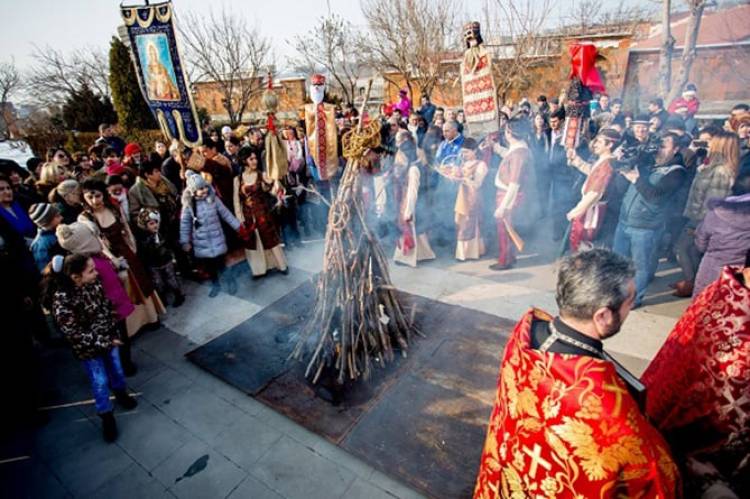




Every year on February 14, the Armenian Apostolic Church celebrates the Feast of the Presentation of the Lord, known as Tyarnndarach, marking forty days after the birth of Jesus Christ.
The feast commemorates the event of bringing the forty-day-old infant Jesus to the temple, in accordance with ancient law and Christian tradition. Over centuries, the Armenian people have preserved this celebration under various names, including Trndez, Tyarnndarach, Tandarej, Tndalesh, Tarinj-tarinj, Dardaranj, Doronj, Melet, and others, reflecting its deep cultural roots.
Christian Meaning of the Feast
The name Tyarnndarach literally means “meeting the Lord” or “going out to meet the Lord.” According to Christian tradition, a woman who had given birth was expected to bring her firstborn child to the temple on the fortieth day, offer sacrifices to God, and receive a blessing.
In accordance with the rites of the Armenian Apostolic Church, the child is baptized on the eighth day, while on the fortieth day the mother comes to the church with her child. The priest presents the child to God and blesses the mother. In the biblical narrative, Mary brings the infant Jesus to the temple, where a righteous elder named Simeon, guided by the Holy Spirit, recognizes Him as the Savior and comes forward to meet Him. This encounter gives the feast its name and spiritual meaning.
Folk Traditions and Customs
Alongside its religious significance, Tyarnndarach is also rich in folk traditions. One of the most well-known customs is lighting a bonfire, often made from wheat stalks, around which people gather to celebrate. Women traditionally bring festive foods such as pokhindz (roasted wheat flour), raisins, aghants, walnuts, and roasted chickpeas, circling the fire with trays before sharing part of the food and saving the rest for the evening meal.
When the flames subside, participants traditionally jump over the fire. These actions are viewed as symbolic rather than superstitious, and the tradition emphasizes celebration rather than obligation.
In the past, people also practiced symbolic fortune-telling by observing the direction of the smoke. Smoke drifting south or east was associated with hopes for a fertile year, while north or west was thought to suggest drought. Special dances involving candles or torches were performed for newlyweds, with married couples forming a protective circle around them.
A particularly interesting custom once observed in the Musa Dagh region involved welcoming the coming of spring. The lady of the house would open doors and windows to symbolically chase away winter and invite spring inside — a tradition remembered today through oral history in some villages.