
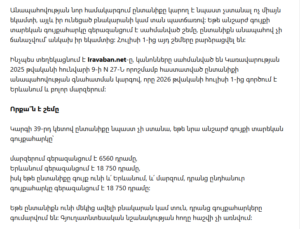
Under Armenia’s updated social vulnerability assessment system, a family may be denied social assistance not only because of its income but also because of the annual property tax assessed on its real estate.
The rules establish specific property tax thresholds. If a household exceeds the applicable limit, it may be classified as ineligible for benefits regardless of how low its income is.
According to information published by Iravaban.net, the requirements are established by Government Decision No. 27-N of January 9, 2025, which regulates the assessment of household social vulnerability.
The system has applied throughout Yerevan and Armenia’s provinces since July 1, 2026.
Importantly, the government increased the relevant property tax thresholds beginning on that date.
What Are the New Property Tax Limits?
Under Point 39 of the assessment procedure, a household may be excluded from social assistance if its annual real estate property tax exceeds the established threshold.
The applicable limits are:
Property location
Annual property tax threshold
Provinces outside Yerevan
6,560 AMD
Yerevan
18,750 AMD
Property in both Yerevan and the provinces
18,750 AMD combined
These amounts refer to annual property tax, not monthly tax payments or the market value of the property.
If a household owns more than one apartment, house or other relevant property, the applicable property tax amounts are added together.
Agricultural land is excluded from this calculation under the cited rules.
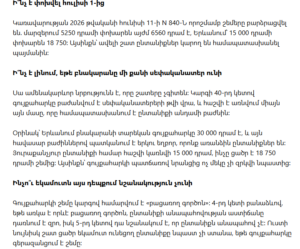
What Changed on July 1, 2026?
The thresholds were increased under Government Decision No. 840-N of June 11, 2026.
Previously, the annual property tax limit was 5,250 AMD for properties in the provinces and 15,000 AMD for properties in Yerevan.
The changes are as follows:
Location
Previous threshold
New threshold
Provinces
5,250 AMD
6,560 AMD
Yerevan
15,000 AMD
18,750 AMD
The higher thresholds mean that some households previously excluded because of their property tax amounts may now satisfy this particular eligibility requirement.
However, meeting the property tax condition does not automatically guarantee social assistance. Families must also meet the other requirements of the vulnerability assessment system.
What Happens When a Property Has Multiple Owners?
One of the most important provisions concerns jointly owned real estate.
Under Point 40 of the procedure, the property tax is apportioned among the owners, and the assessment takes into account the share attributable to the relevant household member.
This means that a family is not necessarily assessed against the entire annual property tax of a jointly owned apartment or house.
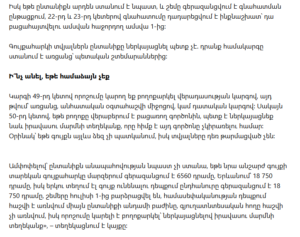
Example: Two Brothers Own an Apartment in Yerevan
Suppose an apartment in Yerevan has an annual property tax of 30,000 AMD.
The property belongs in equal shares to two brothers who live in separate households.
In this situation:
Total annual property tax: 30,000 AMD.
Number of equal owners: 2.
Amount attributable to each owner: 15,000 AMD.
Applicable Yerevan threshold: 18,750 AMD.
Since each owner’s share is below the threshold, neither household would be excluded solely because of the property tax on this apartment.
Other property holdings and eligibility conditions would still need to be considered.
Why Can Property Tax Matter More Than Income?
Under the vulnerability assessment procedure, exceeding the relevant property tax threshold is classified as an exclusion factor.
According to Point 4, the presence of an applicable exclusion factor results in a household’s vulnerability assessment score being set to zero.
Under Point 5, a household with that result is not classified as socially vulnerable for the purposes of the system.
Consequently, even a family with very limited income may fail to qualify for assistance if its annual property tax exceeds the applicable limit.
This distinction is important because the assessment does not rely exclusively on monthly earnings or household income.
It also considers specified property-related and other eligibility conditions.
Can Existing Benefits Be Stopped?
Yes. The rules also apply to households already receiving assistance.
Under Points 22 and 23, if an exclusion factor is identified during the assessment process, the household’s assessment may be terminated automatically.
According to the cited procedure, termination takes effect on the first day of the month following the month in which the exclusion factor was identified.
For example, if the relevant condition is identified in October, the termination would take effect from November 1.
This makes it important for households to ensure that the information recorded about their property ownership is accurate and up to date.
Do Families Need to Submit Property Tax Documents?
Under the described system, families generally do not need to submit property tax information separately.
The assessment platform obtains the relevant data electronically from government databases.
This automated process is intended to reduce paperwork, but it also means that outdated or incorrect ownership records may affect an eligibility assessment.
For example, a property that has already been sold or transferred could create difficulties if the relevant state database has not been updated.
What Can Families Do If They Disagree With a Decision?
Households have the right to challenge decisions concerning their social vulnerability status.
Under Point 49 of the procedure, an appeal may be submitted through the administrative appeals process, including electronically through an individual user account, or through the courts.
However, Point 50 establishes an additional requirement when the appeal concerns an exclusion factor.
In such cases, the applicant must provide documentation issued by the competent authority establishing grounds for not applying that factor.
For example, if a property no longer belongs to the household but remains incorrectly recorded in a state database, official documentation confirming the ownership change may be necessary.
Families who believe their eligibility was assessed using inaccurate information should seek clarification from the responsible social assistance authority.
What Should Applicants Remember?
The most important point is that property ownership alone does not automatically disqualify a household from receiving social assistance.
Instead, the cited rules focus on whether the annual property tax attributable to the household exceeds the applicable threshold.
For properties outside Yerevan, that threshold is 6,560 AMD. For properties in Yerevan, it is 18,750 AMD. Where a household has relevant property in both locations, the combined threshold is 18,750 AMD.
Joint ownership can affect the calculation, and agricultural land is excluded under the specified provision.
The higher limits introduced on July 1, 2026, may allow additional households to satisfy the property tax requirement, although all other eligibility criteria continue to apply.
Families concerned about a refusal or termination of benefits should verify their property records and use the available administrative or judicial appeal procedures when appropriate.
This article summarizes the legal provisions described in the supplied report. Individual eligibility and the application of the rules should be confirmed with Armenia’s competent social assistance authorities.