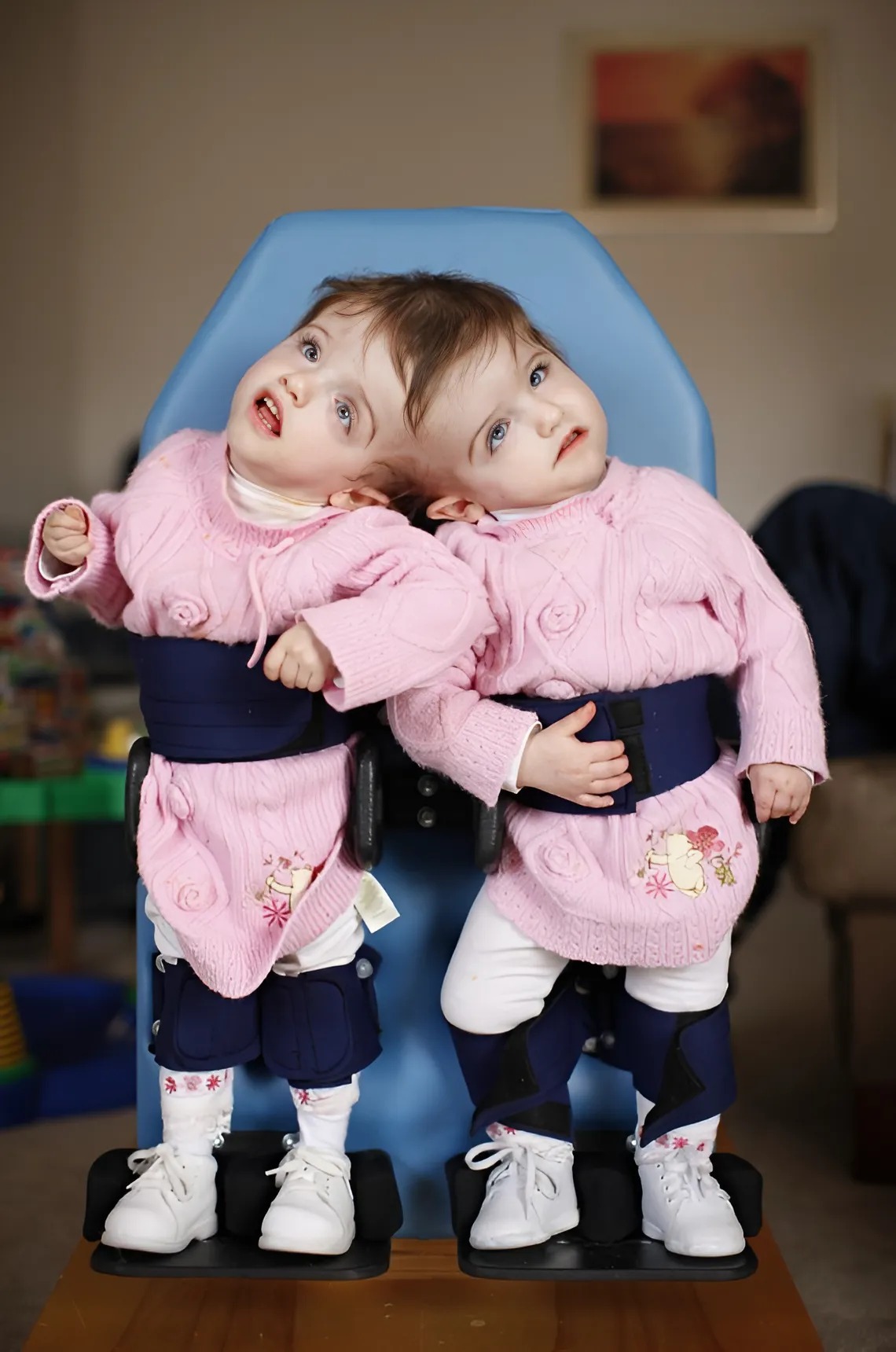
These conjoined twin sisters were born fused at the head and share one brain 😱 Doctors thought they wouldn’t survive even a single day, but they defied expectations — and now they’re 19 years old 😨 Thanks to their shared brain connection, they can feel each other’s pain, taste the food one of them eats, and even read each other’s thoughts 😲😲
See how the sisters look today in the first comment below 👇👇
In 2006, in British Columbia, Canada, something extraordinary occurred that would not only change the Hogan family’s life but also capture the attention of the global medical community.
Tatiana and Krista Hogan were born as conjoined twins, joined at the head. Their case wasn’t just rare — it was unprecedented. The twins didn’t merely share a skull, but they also shared nearly a single brain.
This condition, known as “craniopagus,” occurs in only 1 in 2.5 million births. Typically, these twins don’t survive past the first 24 hours, and only about 20% have any chance of living.
But against all odds, Tatiana and Krista proved the doctors wrong, surviving and thriving well past the predicted timeline.
Their unique connection, called the «thalamic bridge,» links the thalamus areas of their brains. Though each girl technically has her own brain, this strong neural link makes separation impossible.
This rare connection gives them remarkable abilities: they can feel each other’s pain, taste the food one eats, and even know what the other is thinking.
Despite this connection, Tatiana and Krista are still distinct individuals. Tatiana is the more reserved and contemplative twin, while Krista is lively, emotional, and spontaneous.
Their parents have worked tirelessly to ensure the girls live the fullest lives possible.
They learned to swim with a personal instructor, and a custom-built bicycle allowed them to ride together with remarkable coordination.
They can even run, working together in harmony to move as one.
However, life hasn’t been without its struggles. When it was time for preschool, many parents felt uncomfortable with the idea of their children interacting with “special” twins.
Later, the girls attended a mainstream school. Due to the unique wiring of their brains, they faced slight learning delays but still achieved milestones like learning to read, write, and solve basic math problems.