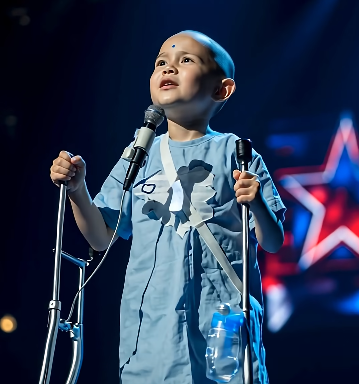
The America’s Got Talent stage has hosted countless memorable performances, but few have resonated with such raw humanity as this one.
Under the gentle spotlight, a little girl appeared, gingerly walking with metal crutches. Each careful step she took echoed louder than any applause. Her movements were deliberate, weighed down with effort. But it wasn’t her condition that moved everyone—it was her unwavering determination. Her strength didn’t come from her legs; it came from something far deeper—a spirit that refused to be silenced.
Dressed in a simple hospital gown, with tags still hanging from her, she looked out at the audience with wide, hopeful eyes. Her head was shaved, likely from treatment, but her face radiated joy, not fear. In that moment, it was clear: this wasn’t just a performance. It was a declaration.
As she approached the microphone, the room fell into a respectful silence.
And then—she sang.
Her first note was fragile, yet filled with life. With each verse, her voice blossomed—carrying not by force, but by raw truth. It wasn’t just music. It was courage in harmony. Sorrow woven into song. The emotion in her voice moved the entire room to tears.
There was something deeply moving about her presence. Though her body trembled, her voice stood tall. Though the journey to the microphone seemed endless, her message was clear from the start: “I am here. I still dream. I still sing.”
She didn’t seek sympathy—she offered strength.
The words she sang were honest, almost too much for a child to express. Yet in her voice, they felt just right. She sang of standing tall when the world tries to knock you down. Of fighting when the weight of life feels too heavy to carry. Of finding light in the darkest moments. Her voice quivered not from weakness, but from the intensity of the emotions she poured into every word.
The judges were visibly moved. Tears welled in their eyes. One whispered “wow” under their breath, while another simply placed their hand over their heart, overwhelmed by the raw power of her performance.
When she finished, there was no dramatic bow, no showy exit. Just a quiet smile. A soft “thank you.” And one last look at the audience, almost as if to say, “I made it.”
But she didn’t just perform.
She reminded everyone what true bravery is.
To stand in front of the world and share your truth—even when that truth is wrapped in hospital gowns, tubes, and scars.
To sing not in spite of your pain, but because of it.
In a world that often prioritizes perfection, this young girl showed us the beauty of imperfection. The grace found in resilience. The music born from survival.
And in doing so, she didn’t just win applause.
She became the voice for every child who’s ever felt small—and made them believe they, too, could sing.