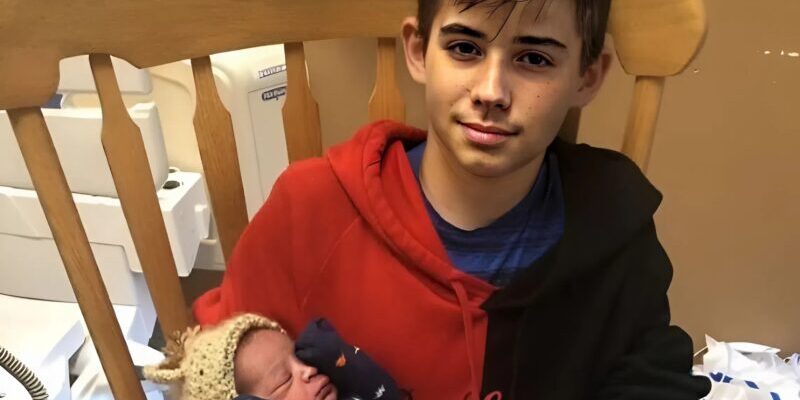
My son became a father at just 15. But what truly frightens me isn’t that.
When Zach texted me from high school saying, “Can you come pick me up? It’s serious,” I had no idea what was about to unfold.
He got into the car without saying a word. His hands trembled, his sweatshirt slightly open, as if he had run out of class. I tried to lighten the mood with a joke: “Did you fail a test? Or get into a fight?”
He simply whispered, “It’s not me… it’s her.”
That’s when I learned the truth. The baby wasn’t his girlfriend’s anymore.
She had left the hospital without signing the papers.
And Zach? My teenage son, addicted to video games and still figuring out how to shave? He was the one who signed them.
Later that evening, he looked me in the eye and said, “If no one else wants her… I do.”
At first, I thought he was joking. After all, he was 15, still trying to remember to charge his phone and take out the trash.
But he wasn’t joking. He was dead serious.
“I don’t know what to do, Mom… but I can’t leave her. I’m the only one who wants to take care of her. I don’t want her to be alone.”
I realized then: this wasn’t some passing whim. This was a decision, one made with an adult’s responsibility. And Zach was ready to face it.
The next few days felt like a blur. We contacted social services, who gently explained that Zach couldn’t handle it all alone. But despite their advice, Zach remained firm: “I want to keep her. I’m ready.”
At first, I thought he was trying to prove something, but soon, I saw that he was committed, even if he wasn’t fully prepared.
One evening, we sat in silence, watching the tiny baby lying in a pink bassinet. Fragile. Dependent. And I had no idea how we were going to make it.
“I just don’t want her to feel abandoned,” Zach said, rocking her. “I know what that feels like.”
It wasn’t until I saw the look on his face that I understood. He wasn’t just talking about the baby. He was talking about himself.
The same Zach who once retreated into video games when life became too much, the one who never showed his emotions, was finally opening up.
“I’m here,” I said softly. “You don’t have to do this alone. We’ll do it together.” But inside, I was terrified. He was so young. Too young. But I knew, if he was committed, I had to stand by his side.
The first few months were a whirlwind. Zach learned to care for her—feeding, changing, soothing a newborn. Sleepless nights. Tears. Doubts.
There were moments when I saw him falter, but I made myself step back. He needed to believe in himself, even if it meant making mistakes and learning from them.
One afternoon, exhausted, he came to me and said, “I can’t do this, Mom. She deserves better than me.”
That broke my heart. But I looked at him and said, “The fact that you’re saying that shows you’re trying. You understand how big this is. And that’s what responsibility is.”
So, we found support—family, counseling, social services—but this time with real help. Slowly, we found a rhythm. Zach learned to be a father. Not in a perfect way, not in the traditional sense, but in a real way.
Then, his girlfriend came back. After abandoning their daughter, she realized she couldn’t walk away. She wanted to share the responsibility. Together, they began to rebuild.
Zach was still unsure, still fragile. But now, he wasn’t alone.
What I hadn’t expected was how much he would change. I feared he’d fail. That he was too young, too lost.
But instead, I watched him grow into someone new. Not a flawless father, but a young man learning, adapting, doing his best. The same boy who once couldn’t spend five minutes away from his console now read stories to his daughter and taught her songs. They laughed together.
I watched him, and in that moment, he taught me something. We often think it’s our job to guide our children. But sometimes, they show us the way.
Zach taught me that maturity doesn’t always come with age—it comes from facing reality with courage.
He reminded me that we don’t have to be perfect to love, to fight, to learn. And most importantly, he showed me it’s never too early to become a good person.