The Zhangjiajie Glass Bridge in China is one of the most breathtaking engineering marvels in the world. Suspended 300 meters above a lush forest with a transparent glass floor, it has long been a hotspot for thrill-seekers. But no one could have predicted that an ordinary morning at this scenic landmark would turn into a nightmare.
Svetlana Mikhailovna, 67, from the Moscow region, had come to China on a guided tour. An active retiree and former physics teacher, she loved hiking and adventure. “If I’ve made it all the way to China, not walking on the most famous glass bridge would be a crime!” she joked on the tour bus.
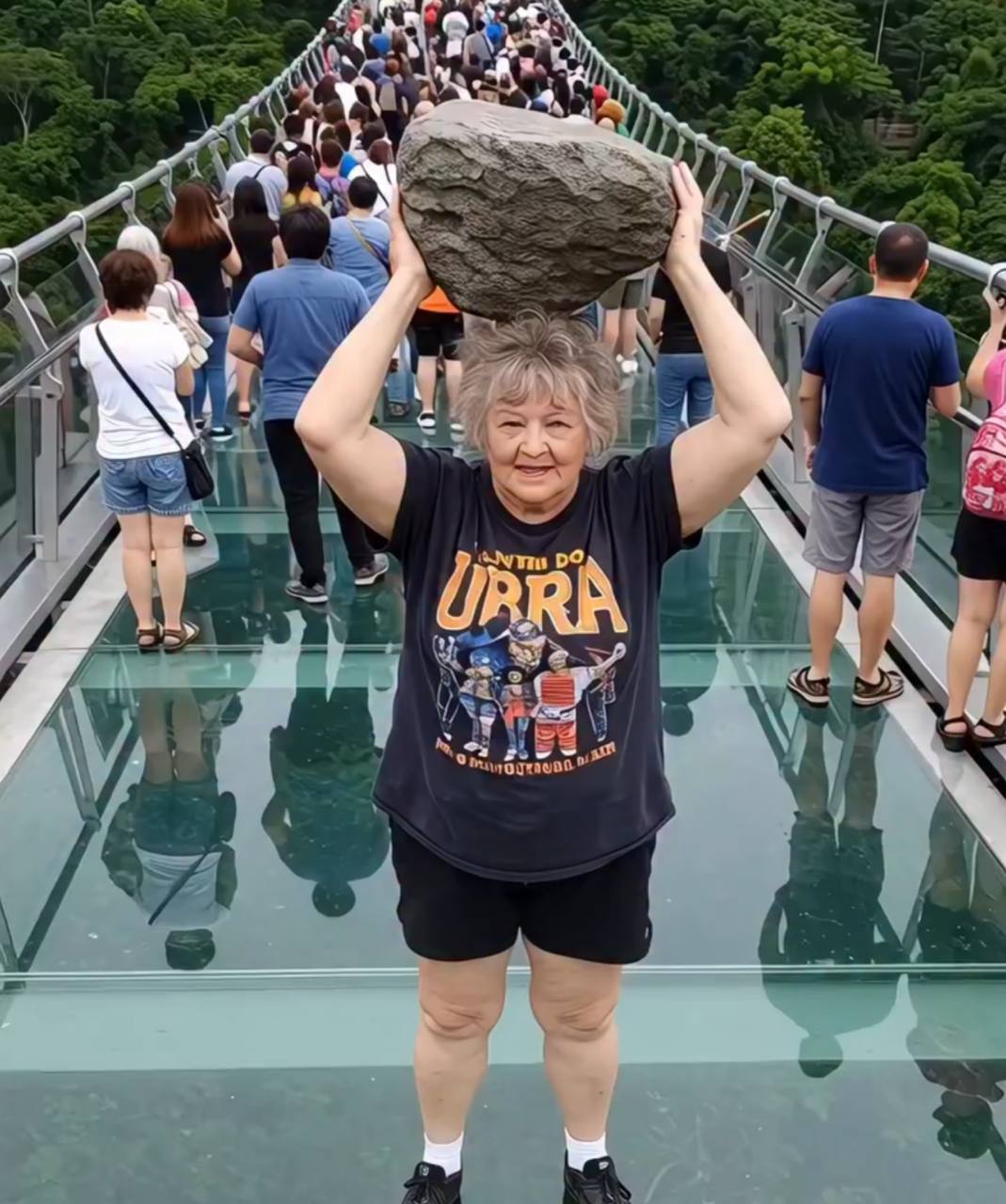
When the group arrived, Svetlana — in her trademark “URRA!” T-shirt featuring Soviet-style superheroes — immediately drew attention. She confidently stepped onto the transparent panels of the bridge and playfully lifted a decorative fake rock placed near the entrance. These props were meant for tourists to pose with — to pretend to “break” the glass. All in good fun.
The bridge was crowded, vibrating slightly under the mass of footsteps. Svetlana, always full of energy, decided to put on a little show for her granddaughter, who was watching live via video call. She knelt, raised the fake rock above her head, and gave the glass a mock “slam” — or so she thought.
But the sound that followed was strangely dull. And, more alarmingly — very real.
Before the stunned crowd, one of the glass panels began to crack. Svetlana assumed it was one of the bridge’s notorious “fake cracking” effects, installed to scare tourists. But the noise and the vibration were far too authentic this time. Moments later, the central part of the floor gave way. The glass didn’t shatter outward — it held together, as tempered glass should — but it became dangerously unstable.
Instinctively, she tried to jump back, but her foot slipped on the now-tilted surface, and she fell — still holding the fake rock. A nearby guide rushed toward her, but it was too late. The weakened glass finally gave out, and Svetlana dropped through the opening.
Seconds later, the cracks spread. Panic erupted on the bridge. People screamed and rushed backward. Some slipped, others clung to the rails. A few more people, along with several fractured panels, collapsed downward — falling about 10 to 15 meters. But miraculously, no one hit the forest floor.
Below the bridge was a hidden safety net — camouflaged to blend in with the jungle canopy. The net was part of the emergency infrastructure, designed to catch anyone in the rare case of a structural failure. But it was never meant to be tested like this.
Thanks to the net, Svetlana and the others survived with only minor injuries and bruises. Rescue teams arrived within minutes and evacuated the scene. The bridge was closed immediately, and all tourists were ushered away.
An official report later revealed that one of the panels in that section had been damaged during maintenance the previous day. It hadn’t been replaced yet, and the bridge operators decided to keep the attraction open, assuming nothing would happen. Svetlana’s harmless stunt with the prop rock turned out to be the final straw for that already weakened panel.
Svetlana unexpectedly became a global headline. Initially dubbed “the grandma who broke the bridge,” she later earned praise as the woman who accidentally prevented a greater tragedy. If the glass had failed later, under even more foot traffic, the outcome could have been far worse.
Her granddaughter later told reporters, “Grandma always said — physics isn’t just something you know, it’s something you feel. I guess this time, she felt it a little too literally.”