As Paul McCartney ripped through the legendary solo of The End at the Corona Capital Festival, the stage ignited with raw, unfiltered rock and roll energy. The night pulsed with electricity, thousands of fans gathered to witness a moment destined for history. At the heart of it all stood McCartney—an icon, a master—proving once more why his influence in music remains unmatched.
The atmosphere reached another level when Jack White stormed the stage, his blistering riffs colliding with St. Vincent’s razor-sharp precision. It was a fusion of eras—McCartney, the eternal legend, trading licks with White’s raw blues-driven fire and St. Vincent’s avant-garde brilliance. The chemistry between them was undeniable, every note charged with an almost supernatural energy.
As the song roared toward its climactic finish, the audience erupted—hands in the air, voices lost in the sheer force of the moment. This wasn’t just another performance; it was a declaration that rock and roll’s heartbeat is as strong as ever. McCartney didn’t just play—he commanded, he inspired, and he reminded the world why his legacy remains untouchable.
Under the dim glow of the stage lights, Bob Dylan took a deep breath and strummed the first aching chords of Roll On, John, his haunting tribute to John Lennon. A hush fell over the crowd, the weight of history pressing down as Dylan’s voice—gravelly, weathered, yet filled with quiet reverence—poured into the night. Each lyric traced Lennon’s journey, from his early days in Liverpool to his eternal place among legends.
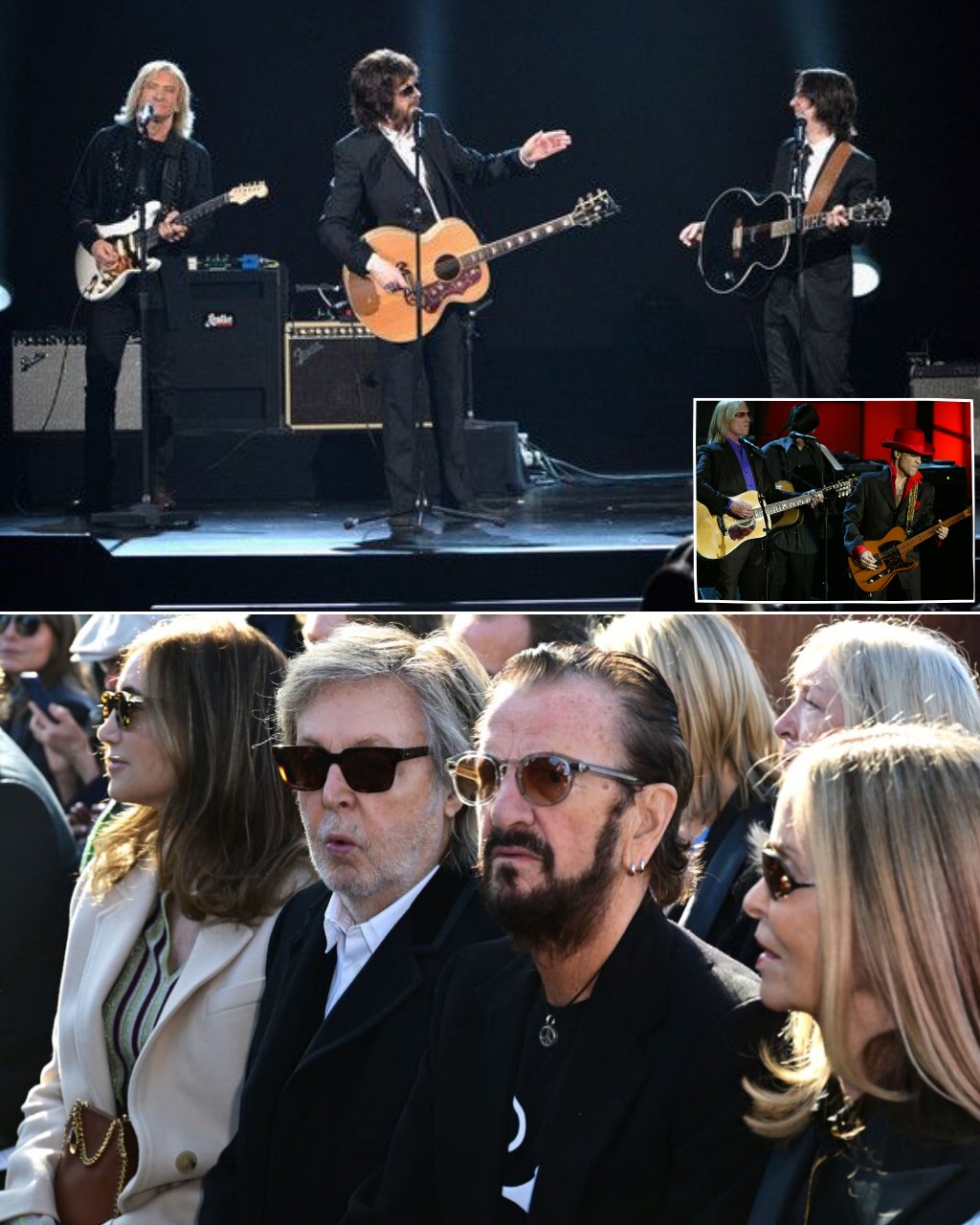
At the 2014 Grammy Tribute to The Beatles, Jeff Lynne, Joe Walsh, and Dhani Harrison took the stage to deliver a mesmerizing rendition of Something. Dhani, a striking reflection of his father, played with quiet intensity, each note a heartfelt homage to George’s brilliance. Jeff’s vocals carried the song’s aching beauty, while Joe’s guitar wept with soul. Watching from the wings, Paul McCartney and Ringo Starr stood with misty eyes—pride, nostalgia, and unspoken memories filling the space between them. As the final chord dissolved into the air, the applause swelled, not just for the song, but for the enduring legacy it represents.
Later, with a single, resonant strum, Bob Dylan’s voice rose once again—rough, defiant, yet deeply moving. His tribute to Woody Guthrie was more than a performance; it was a reckoning, a prayer, a voice for the weary and the hopeful alike. The audience sat spellbound—some swaying, some clutching their hearts, others wiping away quiet tears—fully immersed in the gravity of the moment.