I woke up to the sharp scent of something strange—metallic, bitter—and a lightness around my neck that made my heart drop. The mirror didn’t lie. My hair, my waist-length, carefully grown and cared for chestnut hair, was hacked off in uneven clumps. At first, I thought I’d been robbed, mugged in my own bed. But then I saw the scissors lying neatly on my dresser, the same craft scissors my mother used to cut old receipts. Next to them was a sticky note like a slap to the face: You’ll still look fine. Focus on your speech for Hannah’s big day. Mom.
I lay frozen, the strands of hair still scattered across my pillow, as though a part of me had perished in my sleep. That wedding was supposed to be my moment—the one time I could stand in front of those who had ignored me for years. I dreamed of wearing the navy silk dress I bought with my own hard-earned money, without needing anyone’s approval, and speaking with confidence. But instead, I felt like the punchline of a joke.
When I entered the kitchen, my father barely glanced up from his cereal.
“Good, you’re up,” he remarked. “Less hair makes your face less distracting anyway. The focus shouldn’t be on you.”
My mother sipped her coffee and added, “It’s Hannah’s day. Let her have the spotlight.” They acted like I was a threat to the sun, like my mere presence would ruin everything.
Let me clarify. I was always the daughter they managed, not the one they celebrated. Hannah got designer dresses and violin lessons. I got hand-me-downs and “be grateful” talks. Hannah had a graduation trip to Paris; I worked weekends to pay for college. I moved out at 19, juggling two jobs, but still RSVP’d yes to the wedding, holding onto the hope that maybe—just maybe—it could be a rare family moment without competition. But instead, they drugged me with Nyquil in a cup of soothing tea, then cut my hair while I slept. My own parents.
Becca, my roommate, rushed over when I called her, her voice trembling. She gasped when she saw me.
“They did this on purpose?” she asked.
I nodded.
Becca was silent for a moment, then pulled out her phone. “We’re not going to the wedding like this,” she said. “We’re going to do something better.”
At first, I didn’t want revenge. I just wanted space. But when Becca helped me listen to a voice memo I had recorded weeks earlier, everything changed. It was a recording I’d made out of habit—moments for my therapist: my mom saying I was a distraction when I posted a picture from a friend’s bridal shower, my dad claiming that pretty girls ruined weddings with jealousy. At the time, I thought they were just cruel jabs. But listening back with Becca, I realized it was a pattern. A darker one.
“That’s it,” Becca said. “There’s a way to make them listen.”
That night, I made a decision. I would go to the wedding, but not as they expected. I wouldn’t wear the dress they mocked. I wouldn’t speak the words they gave me for Hannah’s toast. I would take their script and tear it up. And that would be just the beginning.
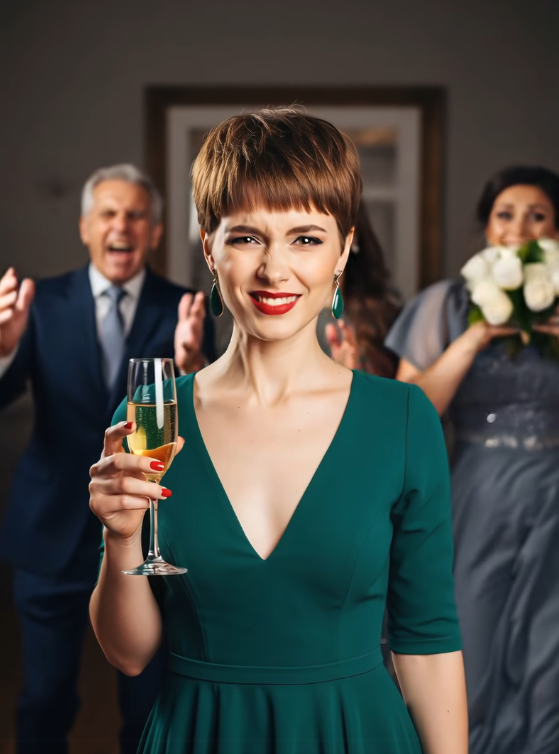
I didn’t sleep. Becca helped me transform my hacked hair into a sleek bob. “You look like someone who’s about to expose a family,” she whispered as she finished styling me.
By morning, I had a plan.
I arrived at the vineyard estate early, before the chaos began. Of course, they chose something picturesque. Hannah’s dream wedding was paid for with my parents’ savings, my mother’s fake smiles, and my father’s unshakable pride in the “real” daughter. I was just a supporting character—but not today.
I’d rehearsed the speech they wanted me to give—some Hallmark nonsense about sisterhood and eternal bonds. But instead, I stepped up to the microphone at the rehearsal brunch, when everything felt smug and warm, and said, “Hi, everyone. I know I’m not the favorite daughter. That’s never been a secret, but today I’m here to say something different.”
The atmosphere shifted immediately. My mother’s smile faltered.
“I want to talk about what goes on behind the family portraits. When people say they love you but cut you down to keep you from shining. When they drug you to make sure you sleep through the sabotage. When parents treat you like a threat to the child they actually love.”
Gasps filled the air. One uncle dropped his fork. My dad stood up. “Enough.”
But I didn’t stop. “You don’t get to rewrite who I am anymore. You don’t get to shrink me, hide me, or pretend this never happened.”
I pulled out my phone and played the recording. My mother’s voice, clear and cold: “She thinks she’ll look better than Hannah. We’ll fix that.” Then my father’s laughter: “We’ll cut it while she sleeps. Girls like her need reminders.”
The silence was deafening. Guests exchanged horrified glances. I finished, “You taught me shame. Now I’m teaching you consequences.”
Security escorted me out as my parents screamed at me. Hannah was in tears—not for me, but because I’d ruined her pictures.
But it wasn’t over.
The video went viral within 24 hours. Becca uploaded the entire clip, captioned, “This is what happens when you weaponize family.” It exploded. Millions of views. Celebrities shared it. TikTokers lip-synced it. Strangers flooded my DMs, saying, “Thank you for saying what I couldn’t.”
The best part? A week later, I received an email from a wedding magazine editor. “Your story is brave,” she said. “We want to feature you. How would you feel about a photoshoot and article called ‘The Uninvited Sister Who Stole the Show?’”
I said, “Yes.”
The photoshoot was everything my parents tried to take from me—elegant, powerful, unapologetically me. They did my makeup, styled my hair, and dressed me in gowns that shimmered louder than any shame. That was the beginning of the second chapter of my life.
Three months later, my family still hadn’t reached out—not to apologize, not to explain. They didn’t need to. The world had already turned its eyes on them. My video had become a cultural moment. Talk shows debated it. Bloggers analyzed every word. Pretty privilege, sister rivalry, emotional abuse disguised as tradition. I had become the voice of every daughter silenced for a shinier sibling.
But I wasn’t after fame. I wanted freedom, and I wanted to make sure no girl was ever silenced again.
It all started with an email from Cynthia Ray, the CEO of a high-end fashion brand known for rebranding damaged reputations. She offered me a job—not just as a model, but as the creative director for a new campaign called You Can’t Cut Power. Photoshoots, press tours, TEDx talks—I turned my pain into purpose.
Meanwhile, the fallout back home was inevitable. The neighborhood grew cold. Wedding guests who once cheered for Hannah now avoided me at the grocery store. The priest who had officiated her wedding told his congregation that she should have asked for forgiveness, not validation. Even Hannah’s new husband, Greg, who had remained silent during the hair-cutting scandal, walked out six weeks after the wedding. He found a box of printed Instagram comments where Hannah had written anonymously attacking me. She wasn’t just complicit—she was obsessed. And now, she was alone.
I wish I could say that made me feel better. But honestly, I didn’t care anymore. I was too busy building something they could never tarnish.
The real revenge came when Cynthia made me an offer. “We’re opening a creative office in your hometown. Want to run it?”
I laughed. “You’re serious?”
She nodded. “Imagine the same town, but this time, you’re the one people want to impress.”
So, I did it. We opened a sleek, sunlit creative space right downtown, on the same street my parents once dragged me past to get to Hannah’s piano recital. This time, it had a giant window decal that read, Power Cannot Be Cut.
The week we launched, we hosted an open house. Local press came. Activists, survivors, even some old high school classmates who had once mocked me showed up, asking for internships.
But the cherry on top? My parents walked in—uninvited, unannounced. My mother wore oversized sunglasses. My father had clearly aged in those few months. Maybe it was guilt. Maybe it was exposure. Maybe it was losing control. They didn’t recognize the woman standing at the front—poised, powerful, camera-ready.
They tried to act like nothing had happened.
“We’re proud of you,” my mother said quietly.
I smiled. “That’s funny. You haven’t been proud of me since I had braces.”
My dad laughed nervously. “We all make mistakes. Families heal, right?”
I walked to the front desk. “Would you like to leave a comment card? We take feedback seriously here.”
They blinked.
“Otherwise,” I said, “I have a full room of people I actually respect waiting to hear me speak.”
As I turned away, I saw them standing there, out of place, uncomfortable in the very space they once thought I was unworthy of. I didn’t need to yell. I didn’t need to shame them. The building, the people, the success—that was louder than any insult.
But just as they left through the glass doors, I called after them, “By the way, next time you try to cut down a daughter to elevate another, just remember: scissors dull, but some girls sharpen.”
They never came back. And I never needed them to. Because I had finally learned: they didn’t define my beauty. They didn’t define my power. And they never, ever had the right to define my worth. Not with scissors, not with silence. Not ever again.
Спросить ChatGPT