I never imagined I’d hear those words from my own mother. The sentence hung in the air like a blade, suspended, cutting without moving, as I froze outside the kitchen door.
My boyfriend of three years, Mark, had stepped away to grab drinks. Now he was there, standing in my mother’s kitchen, listening as she quietly dismantled my life.
«Audrey’s sweet,» she said breezily, «but let’s be honest—Elizabeth has always been the achiever. You deserve someone who will push you forward, not hold you back.»
I watched through the crack in the door as Mark’s expression shifted—from discomfort to something worse: consideration. He didn’t protest. He simply listened.
«Elizabeth just made junior partner at her law firm,» my mother continued, her voice like a knife sliding between ribs. «And what’s Audrey doing with that art degree? Making coffee and sketching portraits no one buys?»
Her words stung, but it was Mark’s slow, thoughtful nod that truly broke me.
I stepped back quietly—my first mistake. Pretending I hadn’t heard.
After that, the changes crept in. Canceled plans. Late nights at work. Subtle mentions of how impressive my sister’s latest courtroom win was. Until the day I unlocked Mark’s apartment, arms full of groceries meant for a surprise dinner, and found my sister’s blouse on the floor.
The sounds from his bedroom confirmed what I already suspected.
When I opened the door, Elizabeth didn’t even flinch. She just looked at me, mildly annoyed.
«You were going to find out eventually,» she said coolly. «Maybe it’s for the best.»
My mother was no different.
«Don’t be so dramatic, Audrey,» she chided when I confronted her. «Elizabeth and Mark make sense together. You’re the dreamer. He needs someone driven.»
And in that moment, I finally understood. To them, I would always be the “lesser” daughter.
«You’re wrong about me,» I whispered. «You always have been.»
That night, I packed my car. My best friend Jamie offered me her couch, but I knew I needed more than a change of address—I needed a change of life. By morning, I left only a note behind:
«Watch me thrive.»
I drove to Chicago with nothing but my art portfolio, two months’ savings, and a determination I hadn’t felt in years. I found a tiny studio apartment and, after nearly a month of rejection, a job as an executive assistant at an investment firm. My boss, Patrick Reynolds, was brilliant but disorganized—a visionary drowning in his own paperwork.
«I’m flexible with job descriptions,» I told him at my interview, «as long as it comes with a paycheck.»
He hired me on the spot.
The work was intense, but I learned fast. Our professional rhythm evolved into mutual respect, then friendship. Late one night, Patrick slid a business plan across the table—his vision for a boutique investment firm focused on sustainable companies overlooked by traditional finance.
«I’m launching next month,» he said. «I want you with me. Not as my assistant—my operations manager.»
It was risky. But it was also the first time someone had seen my potential instead of my “softness.”
«When do we start?» I asked.
The transition from colleagues to partners felt seamless. The shift from friends to something more took us both by surprise. A year later, as we sat cross-legged on my living room floor reviewing financial projections, Patrick looked up from his laptop and simply said:
«Marry me. Be my partner in everything.»
We wed at the courthouse three months later. Our company, Reynolds Capital Partners, flourished. Patrick was the visionary; I built the framework that made his ideas reality. We were true equals.
Five years later, a new opportunity arrived—an acquisition offer involving Meridian Investment Group.
«You might want to see this,» Patrick said over breakfast, sliding a financial magazine my way.
The article reported that my sister’s firm was headed toward bankruptcy—and that Mark, after their failed venture, had taken a lower-level job at Meridian.
«Does this change anything for you?» Patrick asked gently.
His willingness to put my feelings ahead of a smart business decision meant everything.
«Not at all,» I said, squeezing his hand. «It’s just business.»
We decided to celebrate the acquisition with a formal gala—and invited Meridian’s key team. The RSVPs confirmed Mark would attend… with Elizabeth as his wife. To my surprise, my mother also accepted the invitation.
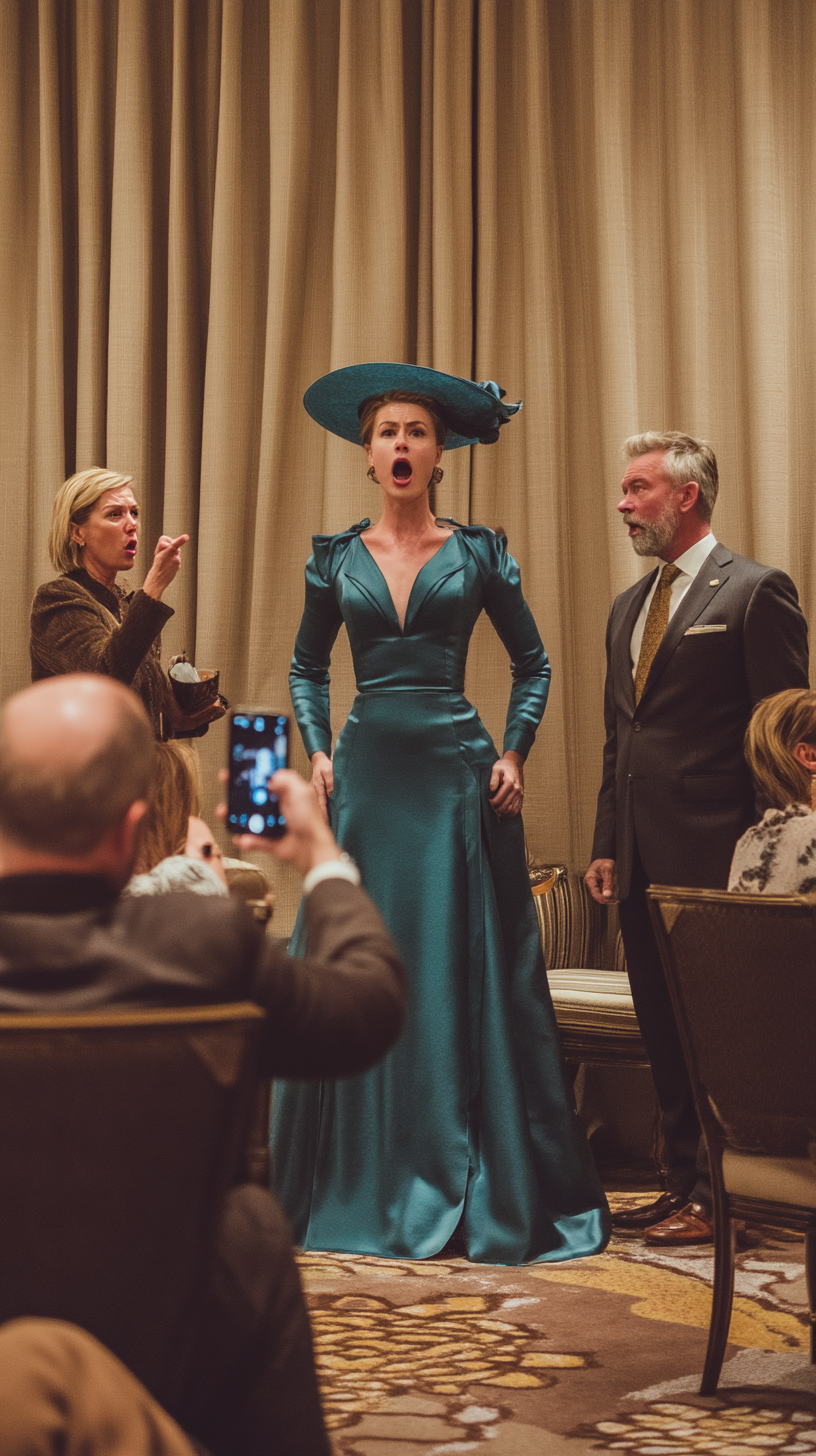
That night, I stood at the entrance of the ballroom in an emerald gown that spoke of quiet power. I wasn’t the fragile girl who had once fled. I was co-founder of the company that now determined their financial futures.
I saw them immediately: Mark, Elizabeth, and my mother—an island of old-money Philadelphia among Chicago’s new elite. My mother’s smile froze for a heartbeat when she saw me.
«Audrey, darling!» she recovered quickly, leaning in with a staged embrace.
«You look stunning.»
«This is my husband, Patrick Reynolds,» I introduced smoothly.
Elizabeth, ever calculating, offered him a polished smile:
«Your reputation precedes you.»
«Our success is a partnership from the start,» Patrick replied, resting a hand gently at the small of my back.
«Audrey’s brilliance made all of this possible.»
Their surprise was palpable. This wasn’t the narrative they’d written for me.
Mark, awkwardly, introduced himself:
«Mark Davis. Compliance officer at Meridian.»
«Yes,» I said evenly, savoring the moment. «The acquisition closed last month. Welcome to the family.»
Later, my mother approached me, her tone falsely warm.
«I always knew you’d do well for yourself,» she said. Then, almost conspiratorially:
«Elizabeth and Mark are having difficulties. Perhaps you could… put in a good word? Family should help family.»
I met her gaze squarely.
«Their performance will determine their future with the company,» I replied calmly.
«Just like mine did.»
That night, after the last guest had left, Patrick and I sat quietly in our kitchen.
«How do you feel?» he asked gently.
«Lighter,» I admitted. «It’s like I finally put something down I didn’t even know I was carrying.»
Strangely, I didn’t feel triumph. I felt grateful.
«If they hadn’t betrayed me,» I told him, «I might never have left. I might never have discovered what I was truly capable of.»
Their betrayal had given me my freedom—though they had never intended to.
And that, I realized, was the most poetic form of revenge: not their downfall… but my rise.